
A strange tug-of-war at the threshold of the end of war: never-ending …
page information

text
A strange tug-of-war at the threshold of the end of war: never-ending tension in the Strait of Hormuz
Written on: June 15, 2026 | Column by current affairs critic specializing in IT/media
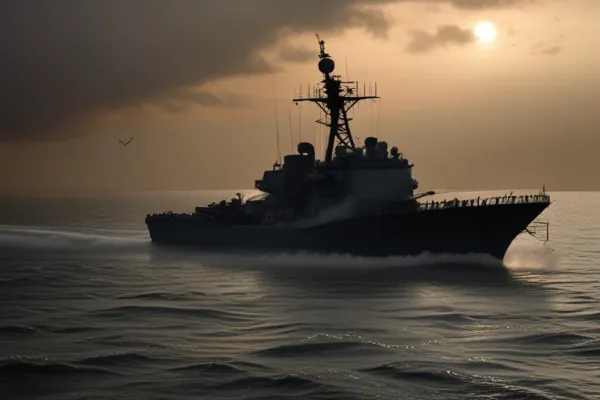
Even though the peace signing ceremony is just around the corner, the smell of gunpowder still lingers in the Strait of Hormuz, known as the artery of the world economy. At this historic moment, when the United States and Iran are about to sign a memorandum of understanding (MOU) that will end years of hostility and promise to end the war, a contradictory situation is being created where a drone is shot down and an explosion is heard. What does the gap between the ink not even dry and the wire carrying live ammunition mean? This incident goes beyond a simple accidental conflict and suggests that the two countries' unyielding strategic pride in their efforts to reorganize the future order in the Middle East are colliding.
The core of this war-ending MOU reached by the United States and Iran is to loosen mutual military shackles. Iran immediately lifted the blockade of the Strait of Hormuz and guaranteed free passage for merchant ships, and the United States responded by agreeing to completely withdraw its naval blockade against Iran within 30 days. In addition, the United States plans to stop imposing new sanctions until a final agreement is reached and sequentially release $25 billion in previously frozen Iranian assets to give Iran some economic relief. Regarding the nuclear issue, the two countries agreed to continue final negotiations on the premise of processing Iran's highly enriched uranium and freezing its nuclear facilities, and in fact, it appears that the two countries have confirmed a major roadmap toward normalizing relations.
However, apart from this promise of peace, the opposite and urgent scenes are being witnessed in the strait. The U.S. Central Command recently officially announced that it had shot down in the air suicide drones launched by Iran targeting commercial ships passing through the Strait of Hormuz. This can be interpreted as Iran's strong will to never give up actual military control within the strait, regardless of the diplomatic process of signing the agreement. The U.S. military is also responding to this by strengthening patrol flights using F-16 fighter jets and maintaining a strong stance that it will never allow the strait to fall under Iranian control.
The essential cause of this conflict lies in the stark difference in perspectives between the two countries regarding the Strait of Hormuz. Iran refuses to return to pre-war conditions and has formalized its stance that it will maintain its military influence in the strait and impose a so-called “service fee” on passing ships. This is a result of Iran's ambition to gain economic and military benefits by considering the strait as a de facto inland sea. On the other hand, the United States defines Hormuz as an 'international waterway', a public good for international trade, and its main principle is to secure free passage without interference from any external forces, so the compromise between the two sides is still far away.
This strange coexistence of diplomatic agreements and physical conflicts clearly shows the complexity of the future situation in the Middle East. While Iran is taking advantage of the lifting of economic sanctions, it is in a situation where it cannot give up its control over the strategically important site of Hormuz. The United States also has the responsibility of maintaining security order in the Middle East, as well as the task of blocking the possibility of Iran's nuclear armament. As a result, the current local battles, such as the shooting down of the drone, can be said to be a high-level battle of wits and a struggle for leadership over who will occupy the position of actual manager of Hormuz after the end of the war.
■ Conclusion and analysis outlook
In the end, the end of the war between the United States and Iran is not something that can be completed simply through a paper agreement. If the signing of an MOU is the key to opening the door to normalization of relations, the conflict over control of the Strait of Hormuz is the biggest and most difficult wall we will face after passing through that door. In order for the two countries to reach true peace, there must be a concrete and realistic agreement on how to jointly manage the international public asset that is Hormuz, beyond economic compensation and limitations on the nuclear program. The current conflict may be the last throes toward perfect peace, or it may be the beginning of another conflict, so the whole world has no choice but to keep a close eye on what is happening on the waves of this strait.
* This post is a commentary by PlayBBS that analyzed real-time Google Trends popular search terms and related major articles.
- Previous postK-Railway’s flight and responsible management: Map to a sustainable future drawn by Hyundai Rotem 26.06.15
- next postA K-mom's daily life unfolds in New Jersey: The light and dark side of the passion for education that comes with a 410,000 won taxi fare 26.06.15
Comment list
There are no registered comments.